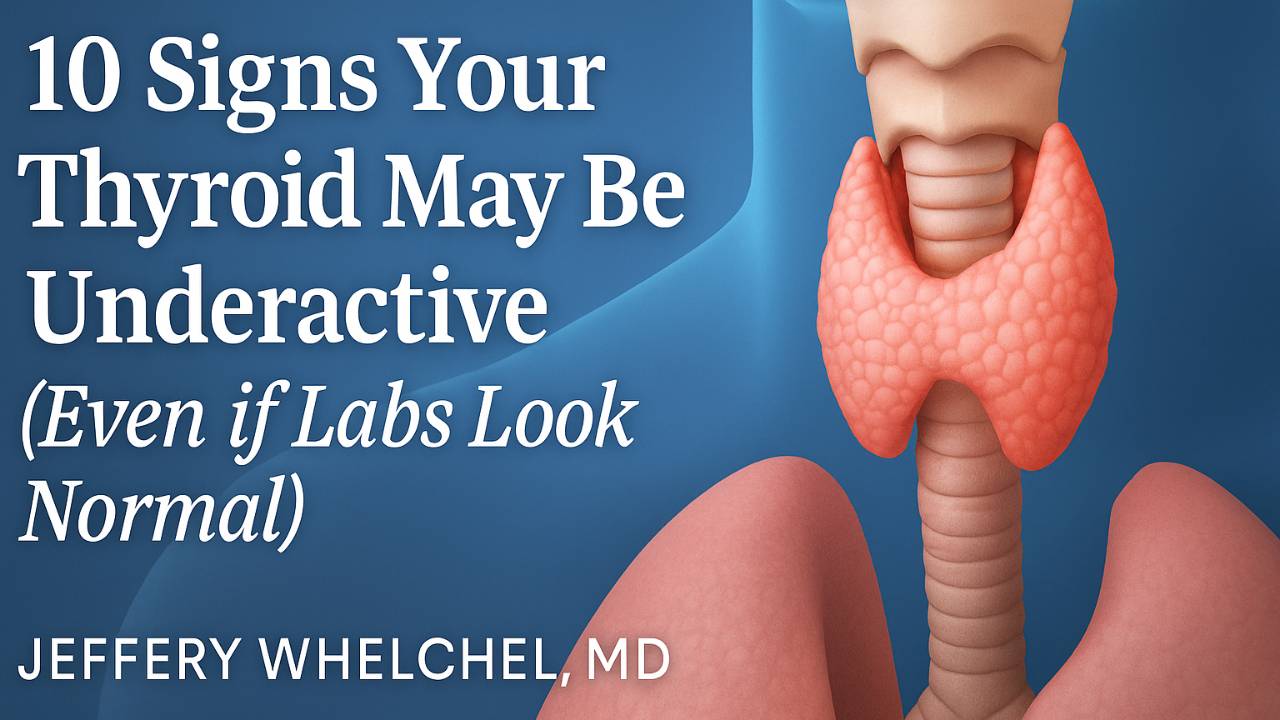
10 Signs Your Thyroid May Be Underactive (Even If Labs Look Normal)
Introduction
If you’ve been told your thyroid labs are “normal” but you still feel exhausted, can’t lose weight, or struggle with brain fog, you’re not alone.
Traditional thyroid testing focuses primarily on TSH (thyroid-stimulating hormone), a pituitary signal that regulates thyroid hormone production. However, TSH does not always reflect what’s happening inside your cells, where thyroid hormones exert their effects.
Many patients continue to have symptoms of cellular hypothyroidism even when their TSH falls within the “normal” reference range. This happens when conversion of T4 (inactive hormone) to T3 (active hormone) is impaired or when reverse T3 (rT3) blocks cellular receptors.
Below are 10 key signs your thyroid may be underactive—even when your lab results say otherwise.
1. Persistent Fatigue
Fatigue is the hallmark symptom of hypothyroidism. Thyroid hormones regulate cellular energy production through mitochondrial activity. When thyroid function is low, your cells produce less ATP, leading to deep, unrelenting fatigue that rest rarely improves.
In one large study, up to 40 % of patients on levothyroxine therapy continued to report fatigue despite a normal TSH.¹
2. Weight Gain or Difficulty Losing Weight
Low thyroid function reduces basal metabolic rate (BMR) and lipid metabolism, making it easy to gain weight even with unchanged diet and activity.
A study from the Journal of Clinical Endocrinology & Metabolism found that even mild thyroid hormone deficiencies can reduce resting energy expenditure by up to 15 %.²
If your free T3 is low, your body burns fewer calories and preferentially stores fat—especially around the midsection.
3. Feeling Cold When Others Don’t
Thyroid hormones are major regulators of thermogenesis. When T3 levels are insufficient, your body can’t maintain temperature, causing you to feel cold even in warm environments.³
This is particularly common in patients with low T3 syndrome or reverse T3 dominance, where thyroid hormone metabolism slows under stress, illness, or calorie restriction.
For more detail, see “Treatment of Reverse T3 Dominance.”
4. Hair Thinning, Dry Skin, and Brittle Nails
Thyroid hormone deficiency slows cell turnover and reduces nutrient delivery to the skin and hair follicles.⁴
Common findings include:
-
Coarse, dry skin
-
Brittle nails with vertical ridges
-
Thinning hair, especially at the outer third of the eyebrows
These symptoms often improve once free T3 levels are optimized.
5. Brain Fog and Memory Problems
Thyroid hormones play a vital role in brain metabolism and neurotransmitter regulation. Low T3 levels are associated with slower cognitive processing, memory lapses, and difficulty concentrating.⁵
Functional MRI studies show decreased cerebral blood flow and glucose utilization in patients with subclinical hypothyroidism, which may explain the “mental fog” so many patients describe.⁶
6. Depression or Mood Changes
Even mild thyroid dysfunction can alter serotonin and dopamine balance.
A meta-analysis of 21 studies found a significant correlation between subclinical hypothyroidism and depressive symptoms, particularly in women.⁷
Addressing low thyroid function can often improve mood stability and reduce the need for antidepressant medications.
7. Constipation and Digestive Sluggishness
Thyroid hormones stimulate smooth-muscle contraction in the intestines. When hormone levels are low, intestinal motility slows, leading to bloating, constipation, and discomfort.⁸
This symptom is often one of the earliest to improve once thyroid levels normalize.
8. Low Heart Rate and Blood Pressure
An underactive thyroid reduces cardiac output and heart rate.⁹
Patients may notice a pulse below 60 bpm or mild dizziness when standing. This reflects a global slowing of metabolism—what used to be called a “slowed constitution” in older endocrinology literature.
9. Menstrual Irregularities and Fertility Issues
Thyroid hormones interact directly with the hypothalamic-pituitary-gonadal axis.
Low thyroid function can cause heavy or irregular menstrual cycles, anovulation, and infertility.¹⁰
Even subclinical hypothyroidism (normal TSH but low free T4 or T3) has been linked to miscarriage and implantation failure in women undergoing IVF.¹¹
10. Swelling or Puffiness (Especially Around the Eyes)
Fluid retention is a lesser-known sign of low thyroid activity.
Myxedema—non-pitting swelling due to mucopolysaccharide accumulation—often appears as puffy eyes, swollen hands, or ankle swelling.¹²
This occurs as slowed metabolism allows interstitial fluid to build up in connective tissues.
Why “Normal” Labs Don’t Always Mean Normal Thyroid Function
Standard thyroid testing typically includes only TSH and sometimes total T4. Unfortunately, these tests may miss the true picture of thyroid hormone activity inside the body.
Many symptomatic patients have:
-
Normal TSH but low free T3 (poor T4→T3 conversion)
-
High reverse T3, which blocks active thyroid hormone receptors
-
Elevated thyroid antibodies (TPO or TgAb) indicating autoimmune thyroiditis (Hashimoto’s)
-
High SHBG (from estrogen therapy or liver conditions) reducing available free hormones
A complete thyroid evaluation should include TSH, free T4, free T3, reverse T3, thyroid antibodies (TPO, TgAb), and possibly SHBG.
In my clinical experience, a significant number of patients require TSH suppression in order to bring free T3 levels into the optimal physiologic range. This often leads to confusion because a low TSH is frequently interpreted as overtreatment or hyperthyroidism. However, this is not always the case.
A suppressed TSH does not necessarily mean a patient is hyperthyroid—particularly if their free T3 remains below 3.0 pg/mL and they continue to experience symptoms of low thyroid function.
Multiple studies confirm that TSH alone is not a reliable indicator of tissue thyroid status, and that many patients with normal or suppressed TSH continue to exhibit low free T3 levels and persistent hypothyroid symptoms.¹³–¹⁵
This reflects the limitation of using TSH alone to guide treatment. TSH is a pituitary signal, not a direct measure of thyroid hormone activity in peripheral tissues. For some individuals, achieving cellular euthyroidism requires optimizing free T3, even if that causes the TSH to fall below the reference range.
What To Do If You Suspect Low Thyroid Function
If you recognize these signs, ask your clinician for a comprehensive thyroid panel and discuss your symptom pattern, not just your lab numbers.
In some cases, improving thyroid function may involve:
-
Treating underlying autoimmune inflammation (Hashimoto’s)
-
Correcting nutrient deficiencies (selenium, zinc, ferritin, vitamin D, and B12)
-
Supporting adrenal and mitochondrial health
-
Considering combination T4/T3 therapy when appropriate
Key Takeaway
Thyroid dysfunction is far more common than most people realize—and it often hides behind “normal” lab results.
The key is looking deeper than TSH and understanding how thyroid hormones behave at the tissue level.
If you’re experiencing these symptoms, don’t accept “normal” as an answer. With the right testing and treatment, you can restore your energy, metabolism, and quality of life.
Next Step
If this article resonates with you, you may be ready for a clearer framework.
I created the Advanced Thyroid Management online course for people who want to understand why their thyroid labs look the way they do and why symptoms often persist despite “normal” results.
👉 Learn more about the Advanced Thyroid Management course
References
-
Peterson SJ et al. Thyroid. 2018;28(6):707–714.
-
Rosenbaum M et al. J Clin Endocrinol Metab. 2000;85(11):4353–4361.
-
Silva JE. Physiol Rev. 2006;86(2):435–464.
-
Slominski A et al. Endocr Rev. 2018;39(5):753–784.
-
Samuels MH. Thyroid. 2014;24(12):1657–1664.
-
Bauer M et al. J Clin Endocrinol Metab. 2009;94(8):2922–2929.
-
Ittermann T et al. J Clin Endocrinol Metab. 2015;100(9):E1254–E1262.
-
Cañete R et al. World J Gastroenterol. 2019;25(24):2991–3006.
-
Klein I, Ojamaa K. N Engl J Med. 2001;344(7):501–509.
-
Krassas GE et al. Ann N Y Acad Sci. 2010;1205:349–360.
-
Kim CH et al. Fertil Steril. 2011;95(5):1650–1654.
-
Baloch Z et al. Thyroid. 2003;13(1):3–126.
-
Hoermann R et al. Front Endocrinol (Lausanne). 2017;8:364.
-
Salvatore D et al. Exp Clin Endocrinol Diabetes. 2022;130(4):248–256.
-
Antonelli A et al. Front Endocrinol (Lausanne). 2021;12:640385.